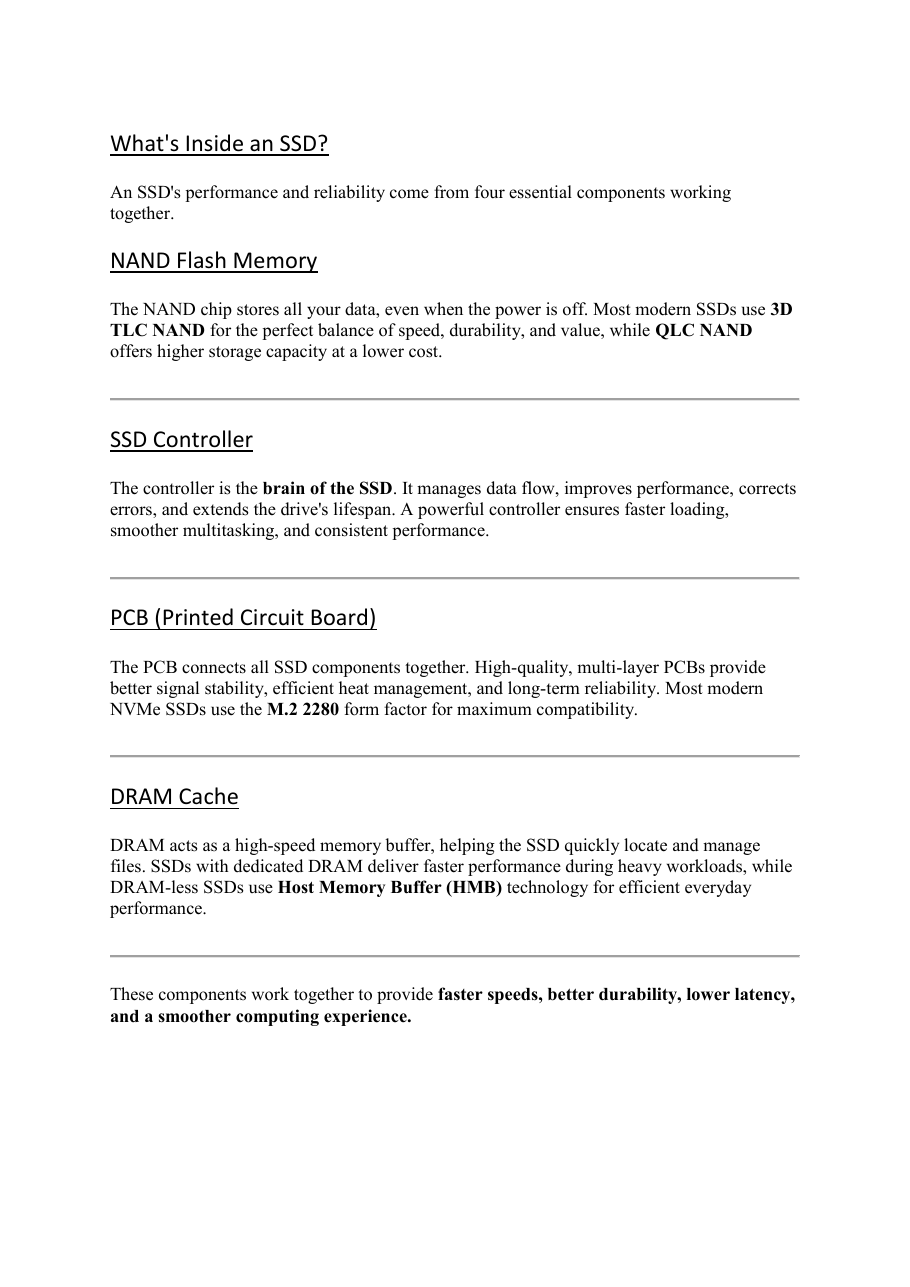
What's Inside an SSD?
Explore the four essential SSD components - NAND flash, controller, PCB, and DRAM or HMB - and learn how they affect speed, endurance, and reliability.
NAND Flash Memory
NAND flash stores data even when the power is off. Modern SSDs commonly use 3D TLC NAND to balance speed, durability, and value, while QLC NAND offers greater capacity at a lower cost per gigabyte.
The quality and type of NAND influence endurance, sustained behavior, capacity, and the workloads for which a drive is best suited.
SSD Controller
The controller is the brain of the SSD. It manages data flow, corrects errors, coordinates NAND, improves performance, and helps extend useful drive life.
A capable controller and well-developed firmware support faster loading, smoother multitasking, and more consistent performance under sustained work.
PCB - Printed Circuit Board
The PCB connects the SSD's components. High-quality multi-layer boards support signal integrity, heat management, power delivery, and long-term reliability.
Many modern NVMe SSDs use the M.2 2280 form factor, combining a compact footprint with broad platform compatibility.
DRAM Cache and Host Memory Buffer
DRAM acts as a high-speed working buffer that helps an SSD locate and manage data efficiently. Drives with dedicated DRAM can maintain stronger behavior in heavy workloads.
DRAM-less designs may use Host Memory Buffer (HMB), borrowing a small amount of system memory to support efficient everyday performance.
How the Components Work Together
No single component determines SSD quality. NAND, controller, firmware, cache, PCB, power delivery, and thermal behavior must work as a coordinated system.
A balanced design produces faster speeds, lower latency, better durability, and a smoother computing experience across everyday and professional workloads.
Download the full guide:
What's Inside an SSD? (PDF)