Understanding NAND Flash Memory
Learn how NAND flash stores SSD data and compare SLC, MLC, TLC, and QLC for speed, endurance, capacity, cost, and practical workloads.
What Is NAND Flash Memory?
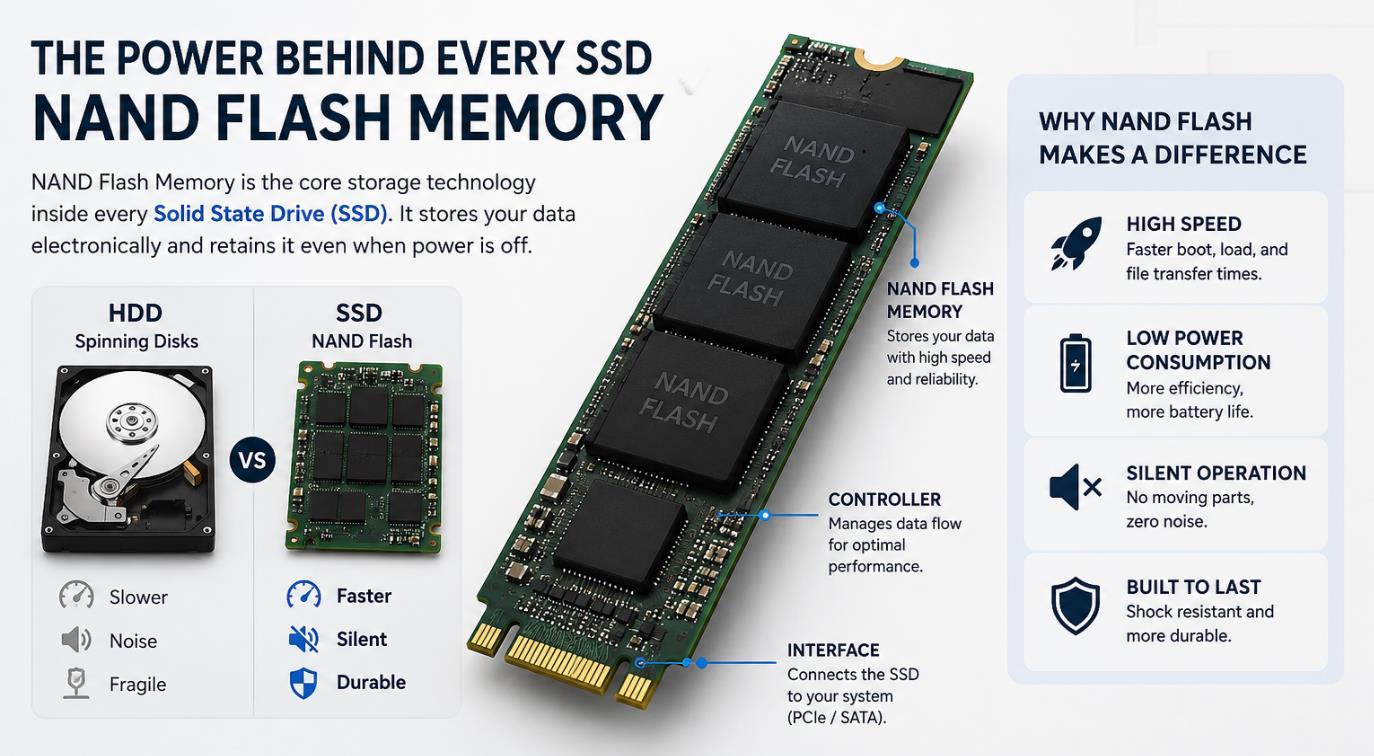
NAND flash is the core storage technology used in solid-state drives. It is non-volatile, meaning stored data remains available even when power is removed.
Unlike hard drives with spinning disks, NAND-based SSDs provide faster access, lower power consumption, silent operation, and greater resistance to mechanical shock.
SLC, MLC, TLC, and QLC Compared
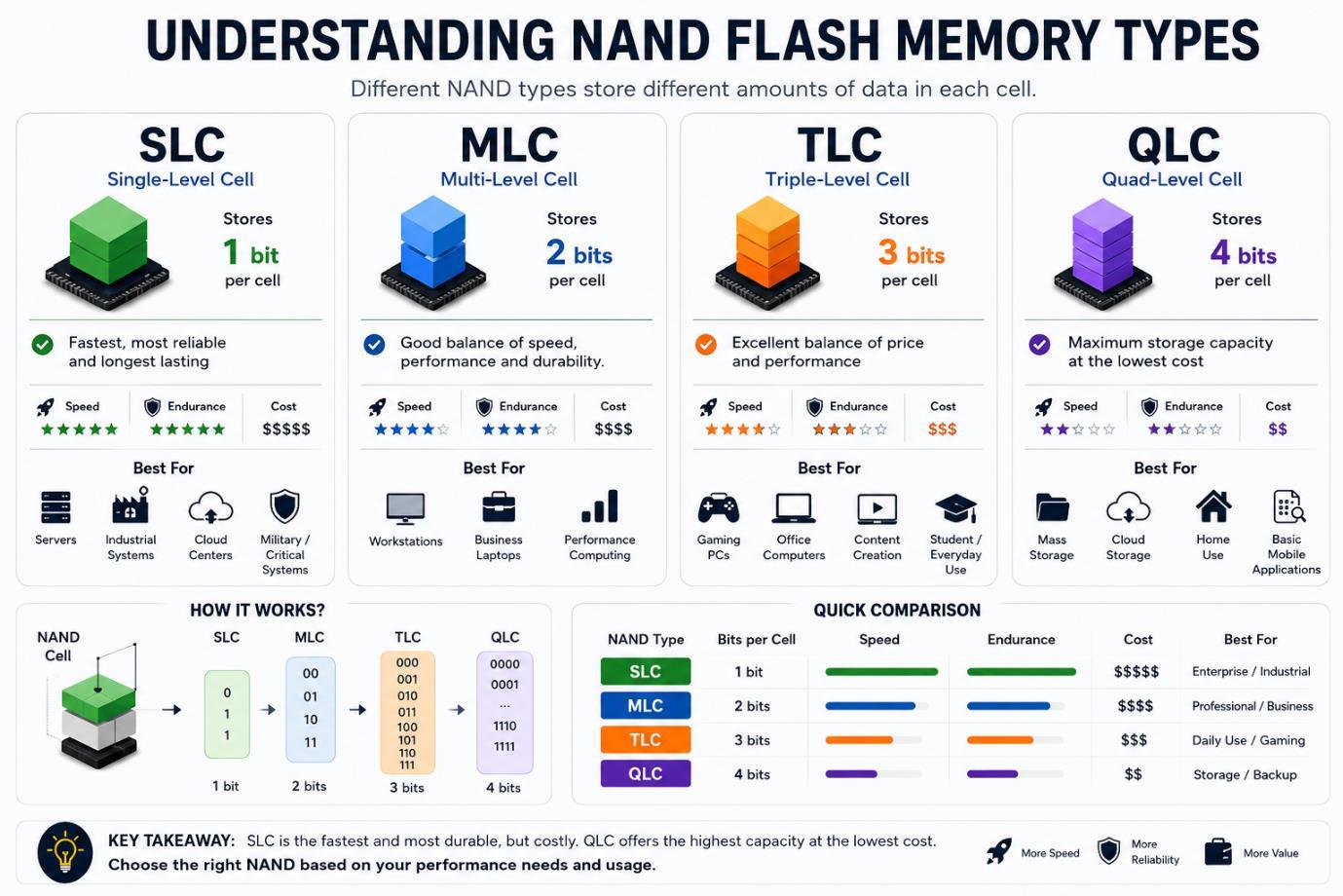
SLC stores one bit per cell and provides the highest speed and endurance, making it suitable for enterprise and mission-critical uses. MLC stores two bits per cell and balances reliability, speed, and capacity for professional systems.
TLC stores three bits per cell and is the most widely used choice in consumer SSDs because it balances performance, endurance, and affordability. QLC stores four bits per cell, maximizing capacity and lowering cost per gigabyte for read-heavy storage and media libraries.
Common Myths About NAND
QLC SSDs are not inherently unreliable. They can be dependable for everyday and read-heavy applications, although their write endurance is generally lower than TLC.
A higher advertised peak speed does not automatically make one SSD better. Controller design, firmware, cache behavior, sustained performance, and workload all influence the result.
Not all TLC drives perform identically. NAND quality, firmware, controller selection, cooling, and cache design can create meaningful differences.
Which NAND Type Is Best?
There is no universal best NAND type. TLC is preferred for many users because it offers a strong balance of speed, endurance, and cost. QLC is useful when capacity and value matter more than sustained write-heavy performance.
NAND cells do have a finite number of program/erase cycles, but modern SSDs use wear leveling, over-provisioning, error correction, and spare blocks to extend useful life and maintain reliability.
Download the full guide:
Understanding NAND Flash Memory (PDF)